Patios and backyard slabs
A stamped patio gives you the look of laid stone or brick in one poured slab, without the gaps between pavers that weeds and ants work into over the years.
Cracked, plain gray patio or driveway? We pour and stamp a new slab that looks like stone or brick, with color suited to its use.
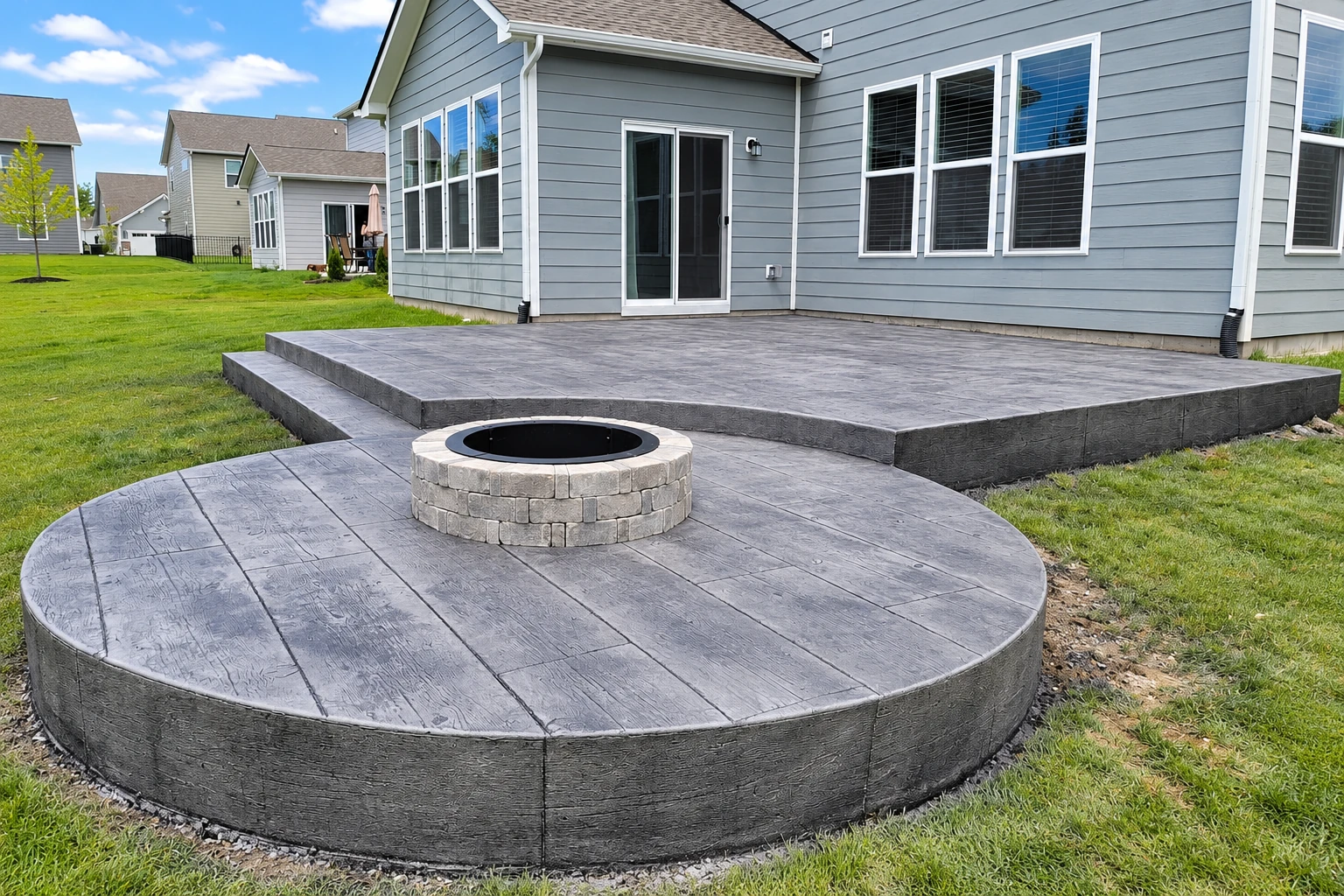
Stamped concrete is fresh concrete that's colored, pressed with rubber mats while it's still soft and then sealed, so the slab looks like stone, brick, wood or tile. Manchester Concrete Works offers stamped concrete services in Manchester, NH and the cities around it across southern New Hampshire and into Methuen, MA.
The price mostly comes down to the size of the slab, how much digging and base work your ground needs, the pattern and the color method you pick. The schedule turns on the weather more than anything, because stamping needs a good window while the concrete is soft, and cold nights can push a pour back. When I come out, I walk the site with you, explain what I see and write down what the price covers, so you know what you're buying before you sign.
We're licensed and insured. Before work starts we check with the city's building office about your job, and when a permit's needed we handle the paperwork for our part of the work or help you file it.
I come out to look at every job myself and work alongside our crew on the build, so the person who walked your yard with you is there when the concrete goes down.
I'd rather spend an extra hour going over patterns, colors and ground work with you than rush a pour, so you know what you're buying before you sign anything.
We're known for driveways, patios and walks, which is where most stamped concrete ends up, so the pattern goes on top of the same kind of slab our crew already builds.
The color method matters as much as the pattern, so before you choose, I show you how each one wears on a driveway compared with a patio. Tires, shovels and winter grit are hard on a driveway in a way patio chairs never are, and the look you like best in the yard isn't always the one that holds up under a car. We settle color, pattern and sealer together, then build the rest of the job around that choice.
Under the pattern, it's the same work as any good slab. We dig out and pack the subgrade, the ground the slab sits on, instead of just raking it level, because loose dirt settles and takes the concrete down with it. We check where the water runs so the slab falls away from your house, set rebar, steel that holds the slab together if it does crack, where the job calls for it, and pour early in the day so the top doesn't bake in the midday heat and turn weak and dusty later.
Once the pattern's pressed, we cut control joints, planned grooves that give the slab a place to crack where you won't notice it, before it can crack on its own. Then it cures, which is the wait while the concrete gains strength before you use it, and we seal it. If the budget's tight, I'll tell you to save on the pattern before the base, because nobody sees the base on day one, and a fancy top on loose ground won't stay flat. See why I'd rather spend your money down there? The same base and timing go into our concrete sidewalk building and garage floor concrete work, so if you need a walk out to the new patio or a garage slab redone, we can plan it alongside.
A stamped patio gives you the look of laid stone or brick in one poured slab, without the gaps between pavers that weeds and ants work into over the years.
Driveways see tires, shovels and winter grit, so the color method and sealer get the most thought here, and a pattern with some texture helps your footing.
A stamped walk from the driveway to your front steps ties the front of the house together, and its border can match a patio pattern so the yard reads as one design.
Around a pool, stamped concrete gives a finished look on a surface people cross barefoot and wet, so we talk through the pattern and sealer with footing in mind.
Send the form and we'll reply within one business day to set a time. I'll walk the site with you, explain what I see and write down what the price covers, free and with no pressure to book.
A rough length and width is plenty to start, even paced off, so I can come out ready to talk about the base, the layout and how the water runs.
Let us know if it's a patio, a walk, a pool surround or a driveway, since that decides which color methods and sealers I'll bring to show you.
Tell us if your lot sits near a lake or pond, because work close to protected water follows extra state rules and we want to plan for that from the start.
Browse stone, brick, slate and wood-plank patterns, plus color and border ideas we can talk through for your patio, walk or driveway.
Straight answers on color, cost, cold weather, winter care, sealing and permits for stamped concrete in Manchester and the cities around it.
One field guide says color hardener is the usual pick for driveways, because it forms a harder skin that stands up to traffic. The catch is the color sits only in the top layer, so a deep gouge shows the gray underneath and uneven spreading looks blotchy. Integral color runs the full depth, so chips match, but it won't reach the deepest or brightest tones.
Installed stamped concrete in Manchester usually costs about $13 to $27 per square foot. That's the going rate for finished work in the area, not our quote. For your own number, I walk the site with you, explain what I see and write down what the price covers.
A Michigan concrete trade group counts it as cold weather when the air falls to 40°F, or is expected to fall below it, while the fresh concrete still needs protecting. Early-fall and late-spring nights can get there, and a pour then risks freezing before it gains strength. I'd rather move a pour than rush one into a cold night.
Start before the pour by asking about air entrainment, tiny air bubbles mixed into the concrete. An Indiana concrete trade group advises cold-region owners to raise it with the contractor first, because it can't be added once the slab hardens. A Michigan group advises sand instead of deicers the first winter, then keeping magnesium or calcium chloride, fertilizer and water-softener salt off it.
One sealing guide says most stamped concrete needs resealing every 2 to 3 years, and heavily used driveways and patios in harsh climates may need it every other year. The same guide warns that a glossy sealer on a pool deck or shaded patio can get dangerously slick when wet, and it suggests a slip-resistant additive.
That's the city's call, so we ask the city's Building Division before we start, because it approves building permits and inspects the work. Right-of-way work along the street will likely need a Public Works permit. Many outdoor permits need a scaled site plan, and work within 250 feet of protected water, such as a lake or pond over 10 acres, follows state rules.
Call (603) 591-9259 or send the form, and we'll plan your color, pattern and pour around the next good stretch of weather.